Understanding the “Open Loop” of the professional nervous system.
Burnout is biological, yet most high-achieving professionals treat it as a moral failing or a lack of discipline. You’ve been told that if you were just “tougher” or managed your time better, you wouldn’t feel this crushing weight at 10:00 PM. But if you find yourself lying in bed, exhausted but wired, scrolling through emails you’ve already read, you aren’t lacking willpower. You are experiencing a physiological lockout.
In high-pressure environments, your nervous system is constantly bombarded by “threats” that don’t look like lions, but act like them. A passive-aggressive Slack message, a sudden pivot in project scope, or the subtle politics of a board meeting all trigger the same survival circuitry. Because these threats never truly “end,” your brain remains stuck in high gear. To fix your sleep, you must first accept that burnout is biological and learn to close the loops that keep your body in a state of hyper-vigilance.
The Science: The Unfinished Stress Cycle
We often confuse “stressors” (the deadlines, the toxic culture, the unread messages) with “stress” (the chemical and neurological reaction in your body). You might finish the report and remove the stressor, but your body is still flooded with cortisol and adrenaline.
In a natural setting, a stress cycle has a beginning, a middle, and an end. If a predator chases you, you run (physical exertion). If you survive, you return to safety, breathe deeply, and your nervous system resets. In the modern office, you cannot run. You sit still, suppress your frustration, and keep typing. Because you never physically “discharge” that energy, your brain never receives the somatic signal that the danger has passed. This is why burnout is biological—your “Danger” switch is physically jammed in the “ON” position, destroying your sleep architecture before you even hit the pillow.
The Mechanism: The Metabolic Cost of Context-Switching
For the young professional, the “Squeeze” of moving between roles—subordinate, peer, mentor, and expert—comes with a massive Neural Cost. Every time you “code-switch” to meet the expectations of a different stakeholder, your brain consumes significant amounts of glucose and norepinephrine.
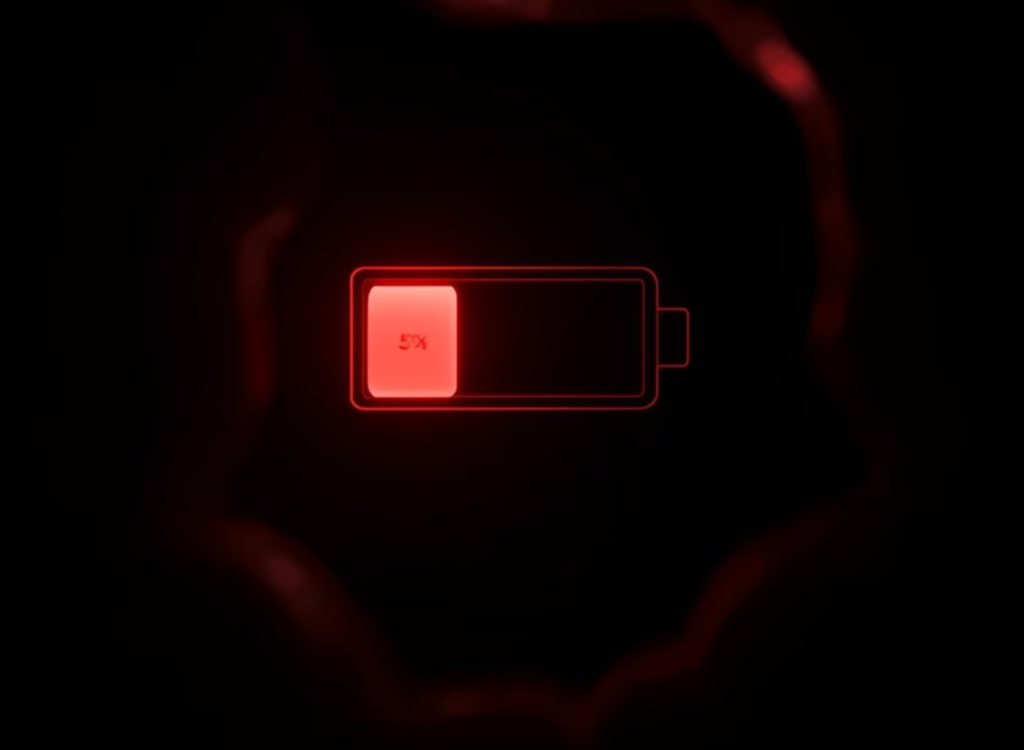
By 6:00 PM, your “Decision Battery” isn’t just low; it’s flat. This biological depletion is why you can handle a million-dollar budget at noon but can’t decide what to eat for dinner at night. Your brain is essentially “idling” at 5,000 RPMs just to keep up with the mental load. When you try to sleep in this state, your brain stays in REM (rapid eye movement) sleep longer, trying to process the day’s anxiety, rather than entering the Deep Sleep necessary for physical repair.
The Protocol: Closing the Loop for Better Sleep
To sustain a high-level career, you must manually bridge the gap between “Work Mode” and “Recovery Mode.”
- The “Transition” Walk (The Somatic Reset): You cannot go straight from a glowing screen to a dark bedroom. You need a buffer. A 15-minute walk immediately after work creates “Optic Flow”—the rhythmic movement of objects past your eyes—which has been shown to naturally quiet the amygdala.
- The 3-Column Brain Dump: Open loops are the primary enemy of sleep. The brain perceives an unfinished task as an active threat. Before leaving your desk, draw three columns:
- Column A: What I Finished (The Dopamine Hit).
- Column B: What I’m Blocking for Tomorrow (The Plan).
- Column C: What is Out of My Control (The Release).
- Non-Sleep Deep Rest (NSDR): If you are “tired but wired,” do not lie there and count sheep. Use a 10-minute Yoga Nidra or Body Scan protocol. This practice leverages “Bottom-Up” signaling to lower your heart rate and shift the brain from Beta waves (active thinking) to Theta waves (deep relaxation), mimicking the early stages of sleep.
- Temperature Anchoring: Since burnout is biological, use biology to fight back. Your core temperature must drop by about 1-2 degrees to initiate sleep. A hot shower 90 minutes before bed causes blood to rush to the surface, resulting in a rapid drop in core temperature once you exit, signaling the brain to release melatonin.
Leadership is an endurance sport, but you cannot win if you never leave the track
The demands of your career are unlikely to decrease, but your ability to recover from them is entirely within your control once you realize that burnout is biological.
At NEST, we help young professionals engineer the recovery protocols necessary to sustain high performance without sacrificing their nervous system.
REFERENCES
Nagoski, E., & Nagoski, A. (2019). Burnout: The Secret to Unlocking the Stress Cycle. Ballantine Books.
Walker, M. (2017). Why We Sleep: Unlocking the Power of Sleep and Dreams. Scribner.
Sapolsky, R. M. (2004). Why Zebras Don’t Get Ulcers. Holt Paperbacks.
Huberman, A. (2021). Master Your Sleep & Be More Alert When Awake. Huberman Lab.